
Education
How to reconstitute your peptide
Every peptide we ship arrives as a freeze-dried powder. Mixing it — reconstituting it — with bacteriostatic water is simple, but the details matter. Follow these steps exactly, then check your product's guide for the water volume and dosing chart specific to that vial.
What you need
- Your sealed peptide vial
- Bacteriostatic water (never plain sterile or tap water)
- A 3 mL syringe with a long mixing needle, for adding the water
- U-100 insulin syringes, for dosing
- Alcohol prep pads
- A sharps container
1. Wash and prep
Wash your hands, clear a clean flat surface, and lay out everything you need before you open anything. Flip the plastic cap off both the peptide vial and the bacteriostatic water.
2. Wipe both stoppers
Wipe the rubber stopper of the peptide vial and the bacteriostatic water vial with a fresh alcohol pad and let them air dry. Don't touch the stoppers after wiping.
3. Draw the water
Using the mixing syringe, draw the exact amount of bacteriostatic water listed on that product's guide — the volume determines your unit math, so don't estimate.
4. Add it slowly
Insert the needle at a slight angle and let the water run slowly down the inside glass wall of the vial. Never spray it directly onto the powder — that damages the peptide.
5. Swirl, don't shake
Let it sit for a minute, then gently swirl or roll the vial between your fingers until the solution is completely clear. Shaking will destroy the peptide.
6. Label and refrigerate
Write the mix date and the water volume you used on the vial. Store it in the refrigerator at 2–8°C. Reconstituted peptides are generally good for about 90 days refrigerated.
7. Draw your dose
Wipe the stopper again, draw your dose in units on a U-100 insulin syringe, tap out any air bubbles, and inject subcutaneously. Use a new needle every single time.
Getting your units right
Doses on this site are written in units on a U-100 insulin syringe: 100 units equals 1 mL. If you mix a 10 mg vial with 2 mL of bacteriostatic water, the whole vial is 200 units, so every 20 units is 1 mg. Change the water volume and every number on the chart changes with it — that's why each guide lists an exact volume.
See per-product dosing charts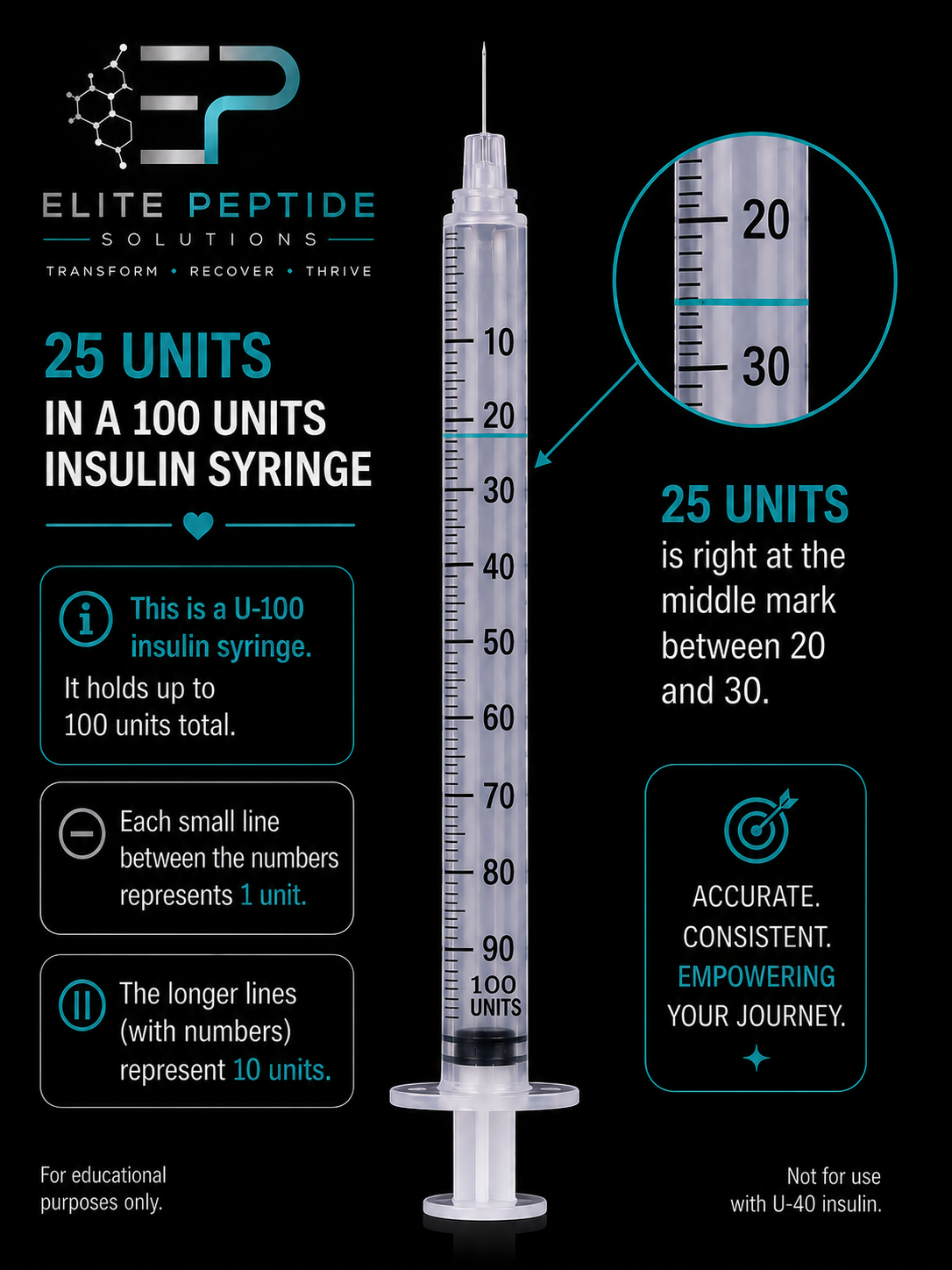
Video walkthroughs
Tirzepatide reconstitution (English)
David walks through preparing Tirzepatide step by step, in English.
Tirzepatide reconstitution (Español)
David walks through preparing Tirzepatide step by step, in Spanish.
Storage
- Unmixed powder: refrigerated at 2–8°C, out of light.
- Mixed vial: refrigerated, roughly 90 days.
- Never freeze a reconstituted vial.
- Discard if the solution is cloudy or has particles.
Common mistakes
- Using sterile or distilled water instead of bacteriostatic water — it has no preservative, so the vial won't keep.
- Shaking the vial to speed it up.
- Spraying water straight onto the powder instead of down the glass.
- Guessing the water volume — it changes how many units your dose is.
- Leaving a mixed vial out at room temperature overnight.
- Reusing needles or skipping the alcohol wipe.